In this Video Funnels AI Review video marketing has exploded over the past few years. But one stubborn problem refuses to go away. The gap between a viewer watching your video and that viewer actually taking action. Most tools address the symptom very few address the roof cause.
Video Funnels AI is one of the rare tools that takes a different approach entirely. Rather than redirecting viewers to an external landing page. After the video ends costing you attention and conversions along the way. It brings the conversion elements directly into the video itself. This review breaks down exactly. How it works, what it does well, where it falls short and who it is actually built for.
This analysis is based on a thorough review of the platform’s features and documented case study data from video marketers who have deployed it in real campaigns.
What Exactly is Video Funnels AI and What Problem Does it Solve?
To understand why this tool matters, you have to understand the single biggest pain point in short form video marketing right now, the link in bio problem.
Someone watches your Reel, TikTok or YouTube Short. They get interested. Then you ask them to stop watching, to to your profile, find the link, tap it, wait for a browser to load a new page and then hopefully take action. That chain of friction kills conversations at every single step, especially on mobile. Most viewers just keep scrolling instead.
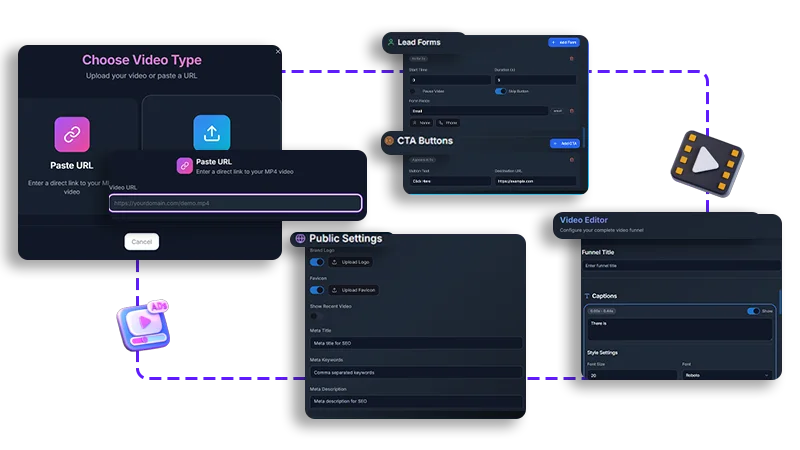
Video Funnels AI sidesteps that entire problem. Instead of redirecting the viewer somewhere else, conversion elements appear directly inside video. As it plays lead forms, buy buttons, countdown timers without interrupting playback or loading a new page.
What separates it from basic overlay tools is the AI layer. Rather than manually deciding when a CTA should appear, the system analyzes the video’s pacing, audio patterns and content flow to recommend the optimal timestamp for each interactive element. The logic is dound viewer attention peaks at specific moments usually right. After a key insight or a natural pause and that is precisely when a CTA is most likely to convert.
How It Actually Works: A Step by Step Guide
Step 1: Import Your Video
You can upload a video file directly from your deivce or past a public URL from YouTube or Instagram. The upload route is more reliable long-term since it keeps your funnel indepndent of third party platforms. The URL import option is convenient but comes with dependency risks covered in the limitations section below.
Step 2: Layer YOur Interactive Elements
Once the video is loaded, you enter the editor and choose from three main overlay types, a lead capture form, a direct buy button linked to any url, or a countdown timer for scarcity based offers. A drag and drop interface lets you position each element on the video frame placement matters here, since covering the speaker’s face or key visuals undermines the viewing experience.
Step 3: Let the AI Suggest Timeline Placement
After you position the visual element, the AI scans the video and suggests when the overlay should appear and disappear on the timeline. User reports indicate the suggestions are accurate around 70 percent of the time, with the remaining cases requiring minior manual adjustment. It functions as a useful analytical starting point rather than a fully automated solution.
Step 4: Publish and Share
Once everthing is configured, you save and receive a sharable link or embed code. The funnel is hosted on the platform’s servers you are not uploading to YouTube or Instagram. This makes it well suited for email campaigns, bio links and direct messages.
What the Data Says About Real World Performance
One of the most cited advantages of in video funnel tools is the measurable reduction in redirect drop off. When a viewer has to leave a video to visit a landing page, research consistently shows conversion rates suffer particularly on mobile, where loading delays and browser switching create additional friction.
Documented user experience with Video Funnel AI report meaningful improvements in opt-in rates. When comparing standard link in bio funnels to in video funnels using the same traffic source. The directional improvement aligns with what conversion rate research predicts: fewer steps between intent and action consistently produces better results.
It is important to note that results vary depending on video quality, audience, niche and offer. The tool improve what happens when a viewer is already engaged. It cannot manufacture engagement from a weak video.
How Video Funnels AI Compares to Sendspark and Vidyard
No tool exists in a vacuum. Before committing to Video Funnels AI, it helps to understand where it sits relative to two well-known alternatives.
Sendspark
Sendspark is built primarily for personalized one to one video outreach. It is an excellent tool for sales teams sending individual video messages to prospects. Has some basic CTA functionally but is not designed around in video lead capture at scale. It serves a completely different use case and runs on a monthly subscription starting around $39 per month. If you are a creator of affiliate marketer trying to capture leads from social video. Sendspark is not the right fit.
Vidyard
Vidyard is the enterprise grade option robust, feature-rich and integrated with most major CRM platforms. It does support in video CTAs and engagement features. However, plans with advanced analytics and integrations start well above $100 per month. For individual creators or small affiliate marketers, the cost to value ratio is hard to justify unless significant revenue is already flowing.
Video Funnel AI
Video Funnels AI sits in a different lane entirely. It is priced as a one time purchase at the front end. Making it accessible to people who want to test in video funnels without committing to monthly subscription costs. It wins on price and on features specifically designed for the affiliate and creator market. The comparison is not really apples to apples each tool is built for a different customer.
The Genuine Pros Worth Talking About
1. Eliminating the Redirect Drop Off
Every redirect costs you viewers. On mobile especially the wait for a browser to load an external landing page creates a gap where attention disappears. Keeping everything inside the video removes that gap entirely. This structural advantage alone makes the tool worth evaluating for anyone doing social video marketing at any meaningful scale.
2. AI Timing That Actually Helps
The AI time stamp suggestions are not just a marketing checkbox. They are a genuinely useful analytical layer. Placing CTAs at psychologically optimal moments, rather than arbitrary points, consistently outperforms guesswork. The tool is not perfect and manual review is still needed. But it shortens the optimization process significantly.
3. Mobile Performance
User feedback consistently highlights that the hosted funnels load quickly on mobile connections. Given that the majority of social video traffic is mobile, fast rendering of interactive elements is not a niche to have it is critical.
4. Cost Structure
For anyone who has priced out a full video marketing stack a video host, a funnel builder and a lead capture tool. The consolidation into a one time purchase is genuinely attractive. Monthly subscriptions accumulate fast and replacing $80 to $150 per month in recurring costs with a single payment has a clear and calculable payback period.
The Real Limitations You Should Know
1. Front – End Funnel Limits
The base purchase limits how many funnels you can create. For a single campaign or concept test, that is fine. For agencies managing multiple clients or marketers running several offers simultaneously. The unlimited upgrade (OTO 1) is essentially a requirement. Budget for it from the start to avoid a frustrating mid campaign celling.
2. Your Video Still Has to Do the Heavy Lifting
This cannot be said clearly enough, no funnel tool can rescue a bad video. If the content does not hook the viewer within the first few seconds. They will scroll away before any overlay ever appears. Video Funnels AI improves what happens when someone is already engaged. It cannot manufacture engagement from nothing.
3. The URL Import Dependency Risk
If you import a video via a YouTube or TikTok URL rather than uploading your own file, Your funnel is tied to the continued availability of that video on the original platform. If it gets deleted, removed for a copyright issue or the account is suspended, your funnel goes dark with it. For any core campaign asset, always upload your own file.
4. Overlay Styling Takes Practice
Getting overlays to feel native blending with the video’s look rather than sitting on top like a banner ad requires deliberate design attention. Matching colors and fonts to the video’s aesthetic makes a significant difference in how professional the final result appears. The editor gives you the tools to do this. But it is not automatic. Except a learning curve early on.
Who Should Actually Buy This?
Based on the tool’s design, pricing and features set, Video Funnel AI is the right fit for a specific type of user.
It Makes a Strong Sense For
- Content creators and affiliate marketers driving traffic primarily through short form social video.
- Marketers frustrated by low conversion rates from link in bio setups.
- Creators building email list through video content who want to capture leads without external page redirects.
- Solo Marketers looking to consolidate tools and eliminate recurring subscription costs.
It is Probably not the right fit for
- Teams that need CRM integrations and enterprise analytics (Vidyard is a better fit)
- Sales teams focused on personalized one to tone outreach.
- Marketers whose primary traffic sources is not video.
Final Thoughts
Video Funnels AI addresses a real structural problem in social video marketing and it does so in a way. That is both practical and accessible. The core concept of keeping conversion elements inside the video. Rather than forcing a redirect is backed by solid conversion rate logic and the AI timing layer adds genuine value rather than serving as a marketing gimmick.
It is not a silver bullet. A weak video will still underperform no matter how good the funnel is. But for marketers who are already producing engaging video content and losing conversions in the redirect gap. This tool offers a credible and cost effective solution.
If you are on the fence, the one time cost structure keeps the risk low enough to test it against your current funnel on the same traffic source for two to three weeks and measure the differnece yourself.
Please Note: This post contain affiliate link. If you click and make a purchase, I may earn a commission at no additional cost to you.

I am Vivek, a digital marketer and blogger based in India with 3+ years of experience testing online tools and software.